Why the Grip on a Ball Is More Than Texture
Ball grip is shaped by pattern, material and contact, not texture alone. Learn what to inspect and how to judge a surface for your own handling.
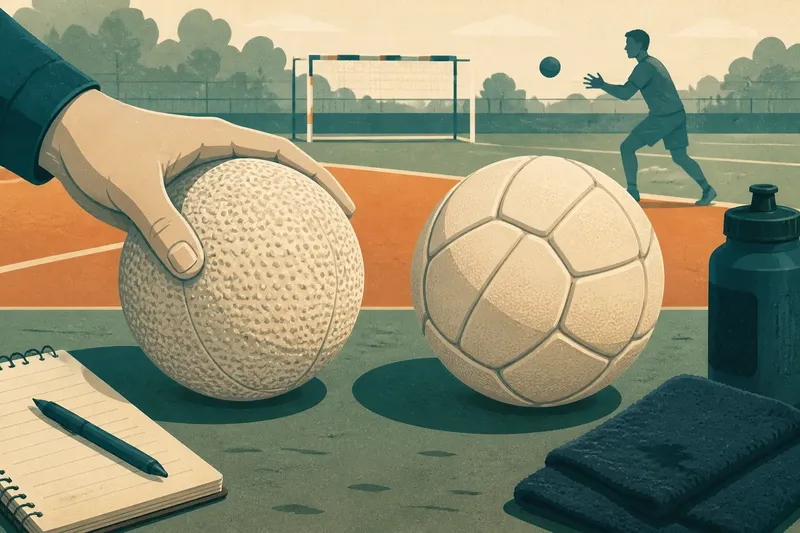
A ball slips from a damp palm during a warm-up, and the first instinct is to blame its smooth finish. Ball grip is not simply a matter of roughness: the pattern, the material beneath it and the way the surface meets a hand all contribute to handling and feel. Knowing what to look for can help you choose a ball without treating a bold performance claim as a description of your own experience.
What does ball grip actually describe?
Grip is the interaction between the ball’s outer surface and the hand, glove or other contact point. It can influence how securely the ball sits, how it releases and how clearly a player can sense its position. These are related sensations, but they are not interchangeable. A ball may feel secure while held and still feel unfamiliar during a throw.
Texture is one part of that interaction. A pebbled, dimpled or ridged finish gives the surface a particular tactile character, while the pattern determines where those raised or recessed areas sit and how they repeat. Two balls can look similarly rough yet feel different because their patterns, materials or surface construction differ.
The result also depends on the player and the circumstances. Hand size, technique, moisture, gloves and the ball’s intended use all affect contact. A surface description can tell you something about the object; it cannot, by itself, settle whether that object will feel right in your hands.
How do pattern and texture change contact?
A repeated surface pattern breaks up the contact area into smaller regions. Depending on its shape and spacing, the pattern may give fingers recognisable points of contact, or it may feel more continuous. Raised details can be prominent under the fingertips; finer texture may feel quieter, even if it remains visible.
Pattern placement matters as well as pattern shape. On some balls, seams, channels or panels create distinct lines across the surface. These can provide reference points for holding and positioning the ball. A player who relies on a particular finger placement may notice them more than someone who holds the ball in a different way.
Texture also changes the impression of the material. A soft-feeling surface can seem forgiving in the hand, while a firmer or more pronounced finish may feel defined. That first impression is useful, but it is not a reliable stand-in for every kind of handling: a ball that feels pleasant at rest can behave differently when caught, passed or released at pace.
There is no single ideal pattern. A design that feels legible to one player may feel distracting to another, and a pronounced texture is not automatically more secure. The useful question is whether the surface gives you the kind of contact and feedback you need for the way you play.
What should you notice during a week of choosing?
A week gives you a modest routine for comparing feel without turning the decision into a laboratory project. Keep the conditions ordinary, use the same kind of contact where possible, and note what you notice rather than trying to prove a broad claim. If you are choosing for organised play, first check the ball’s suitability for that use; a pleasant surface cannot make an unsuitable ball appropriate.
- At the start of the week: Identify the ball type and the handling tasks that matter to you, such as catching, passing or control at close range. Write down what currently feels comfortable and what feels awkward.
- On the next session: Inspect the surface in good light. Look for the pattern’s shape, the spacing of raised details, any seams or channels, and whether the texture is uniform across the areas you normally touch.
- At the following session: Handle the ball with dry hands and pay attention to where your fingers settle. Notice whether the pattern is easy to read by touch or whether you keep searching for a familiar position.
- At another ordinary session: Repeat the same kind of action with the ball you already know, if one is available. Compare the feeling of contact and release, rather than declaring one surface better in every respect.
- Later in the week: If damp conditions are part of your normal play, observe how each surface feels then, using sensible conditions and suitable equipment. Do not infer that a dry-hand impression predicts wet handling.
- At the end of the week: Decide which qualities matter most to you: a clear tactile pattern, a smoother feel, familiar placement or a particular response in use. Treat promotional language as a prompt for questions, not as a substitute for this preference.
Say you are choosing between a ball with small, closely spaced dimples and one with broader raised panels. Imagine that the first feels more continuous in your dry hand, while the second gives your fingers clearer landmarks but seems intrusive on release. The practical choice depends on which sensation matters more for your usual play; the surface description alone does not decide it.
How should you read claims about ball grip?
Words such as “enhanced”, “high-grip” or “all-weather” compress several design ideas into a short label. Ask what feature the wording points to: a particular surface pattern, a coating, a material or a stated use. If the description gives no concrete feature or conditions, it tells you little about what the ball will feel like to you.
Separate a design description from a performance promise. “Raised channels” describes something you can inspect; a claim that the ball improves control is a broader conclusion that depends on player, conditions and task. A visible texture can support a particular feel, but it cannot establish that every user will handle the ball better.
Where relevant, check the manufacturer’s description and the rules or requirements for your intended setting. If the claim matters for a particular competition or activity, confirm the applicable requirements rather than relying on a product phrase. The wording on a box is not a technical specification merely because it is printed neatly.
It is not worth trying to rank every surface by how rough it looks, or rubbing a ball repeatedly in a shop and treating that as a verdict. A brief tactile check can identify a preference; ordinary use is more informative about whether that preference suits your handling.
What questions help you judge a ball surface?
Does a rougher ball always provide more grip?
No. Roughness is only one feature of the surface, and its effect depends on the pattern, material and conditions of contact. A rough feel is not a universal measure of secure handling.
Do seams and channels count as texture?
They are surface features that can affect how the hand locates and holds the ball, though they differ from an all-over pebbled or dimpled finish. Their usefulness depends on where they fall relative to your grip and how you use the ball.
Can a ball feel grippy but still be hard to handle?
Yes. A surface may feel pronounced in the hand yet be unfamiliar during a catch or release. Consider the whole action you need, not just the sensation produced by pressing a fingertip against the ball.
Should I choose the same texture as another player?
Not necessarily. Hand size, technique, glove use and personal preference can all change how a pattern feels. Another player’s preference is a useful question to ask about, not a decision you need to inherit.
Which details should settle your choice?
Bring the choice back to observable details. Can you identify the surface pattern? Does the ball offer contact points you can locate comfortably? Does its feel remain acceptable during the actions you actually perform? These questions are more useful than asking whether the ball has the most texture.
Ball grip is best understood as a relationship between design and use, not a property that a product name can settle. Look at the pattern, notice the feel under the conditions that matter to you, and keep performance language in its proper place. The most useful surface is the one whose contact you can read and work with in your own game.